



Overview #
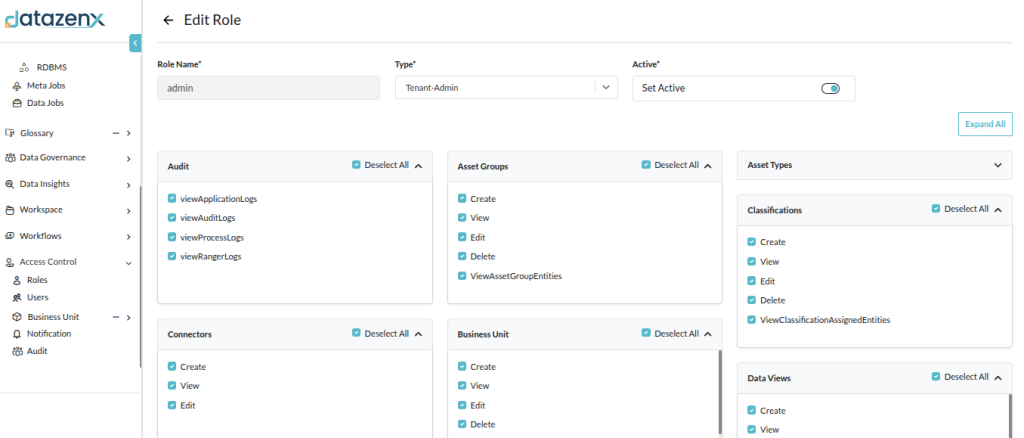
DatazenX uses a role-based access and responsibility model designed to support collaboration while maintaining strong governance, security, and compliance.
Each role in DatazenX:
- Has clearly defined responsibilities
- Operates within controlled access boundaries
- Interacts with data through governed workflows
- Aligns with enterprise organizational structures
This model ensures that data can be widely used across teams without compromising trust or control.
Role-Based Interaction in DatazenX #
DatazenX supports multiple roles across the data ecosystem. While each role interacts with the platform differently, all roles operate within a shared governance framework.
IT Admins #
IT Admins are responsible for platform configuration and governance foundations.
Key responsibilities include:
- Configuring authentication and identity providers
- Managing users, roles, and permissions
- Defining organizational structure, business units, and departments
- Overseeing platform-level security and access controls
- Ensuring system availability and compliance readiness
IT Admins establish the governance and access baseline for the organization.
Data Engineers #
Data Engineers focus on data ingestion, pipelines, and operational reliability.
They typically:
- Connect data sources and manage integrations
- Monitor ingestion pipelines and data freshness
- Handle schema changes and structural updates
- Ensure data flows remain reliable and consistent
- Support downstream data consumers with accurate data
Their access is designed to enable operational control without bypassing governance.
Database Administrators #
Database Administrators oversee database-level governance and performance considerations.
They:
- Manage database integrations and credentials
- Control access to underlying data systems
- Ensure alignment between source-level permissions and DatazenX policies
- Monitor performance and structural constraints
This role ensures that source systems and DatazenX remain synchronized in terms of access and control.
Data Analysts & Data Specialists #
Data Analysts and Specialists interact primarily with curated and trusted data.
They:
- Discover datasets using the data catalog
- Understand definitions, classifications, and lineage
- Analyze data using approved views and products
- Validate data suitability for reporting and analysis
Their access emphasizes read-only or governed interaction to preserve data integrity.
Business Analysts #
Business Analysts focus on interpreting data for decision-making.
They:
- Access governed datasets and metrics
- Use data views and data products
- Interpret KPIs and business definitions
- Generate insights and reports for stakeholders
Their experience is designed to prioritize clarity, trust, and usability over technical complexity.
Data Stewards #
Data Stewards are responsible for data meaning, quality, and accountability.
They:
- Define and maintain business terms and glossary entries
- Assign ownership and stewardship
- Enforce data standards and classifications
- Review and approve metadata changes
- Ensure data quality and consistency
Data Stewards play a critical role in maintaining enterprise data trust.
Monitoring & Auditing Teams #
Monitoring and Auditing Teams ensure oversight, traceability, and compliance.
They:
- Monitor data access and policy enforcement
- Review audit logs and activity history
- Track changes to data assets and metadata
- Support internal audits and regulatory reviews
Their access is intentionally read-only and visibility-focused to maintain independence.
Access Control Principles #
Access in DatazenX is designed around governance-first principles rather than unrestricted permissions.
Key principles include:
- Role-based access – Permissions are tied to roles, not individuals
- Least privilege – Users receive only the access required for their responsibilities
- Permission inheritance – Access cascades through business units, projects, and assets
- Separation of duties – Critical actions require appropriate roles or approvals
- Policy-driven enforcement – Access rules are governed by defined policies
These principles ensure consistency, security, and scalability across the organization.
Business Units & Segmentation #
Business Units and Departments provide organizational context for access control in DatazenX.
They are used to:
- Define data ownership and stewardship boundaries
- Control visibility of datasets and insights
- Apply policies at organizational levels
- Align access with real-world teams and domains
By structuring access around business units, DatazenX supports domain-based ownership while maintaining enterprise-wide governance.
Collaboration Without Compromising Control #
Although roles define responsibilities and access boundaries, DatazenX is designed to support cross-functional collaboration.
Shared catalogs, governed workflows, and transparent lineage allow teams to work together confidently, without granting excessive permissions or bypassing controls.
FAQ #
1. Can one user have multiple roles in DatazenX?
Yes. Users can be assigned multiple roles depending on their responsibilities.
2. How does DatazenX prevent unauthorized data access?
Through role-based access control, least-privilege principles, and policy-driven enforcement.
3. Are permissions applied at dataset or column level?
Yes. Access controls and policies can be applied at multiple levels depending on classification and sensitivity.
4. How does DatazenX support separation of duties?
Critical actions such as approvals, access changes, or policy overrides require appropriate roles or workflows.
5. Can roles be customized to match our organization?
Yes. Roles and permissions can be tailored to align with enterprise structures and governance models.