



Datazenx offers a unified platform for managing, analyzing, and consuming data efficiently:
- Seamless Collaboration: Align technical and business users with shared access to Data Products, Views, and KLists.
- Governed & Trusted Data: Metadata, lineage, and access policies ensure quality and compliance.
- Reusable Assets: Save time with Data Views and KLists for repeated analysis across projects.
- Actionable Insights: Empower teams with clear, traceable, and consumable data for strategic decisions.
Insights, Analytics & Consumption #
From Data to Actionable Insights #
At Datazenx, we transform raw datasets into curated, query-ready views and reusable data products that empower organizations to make informed decisions. Our Data Insights ecosystem ensures that every dataset is accessible, governed, and ready for analytics, enabling business users and data teams to derive actionable insights efficiently.
Data Views #
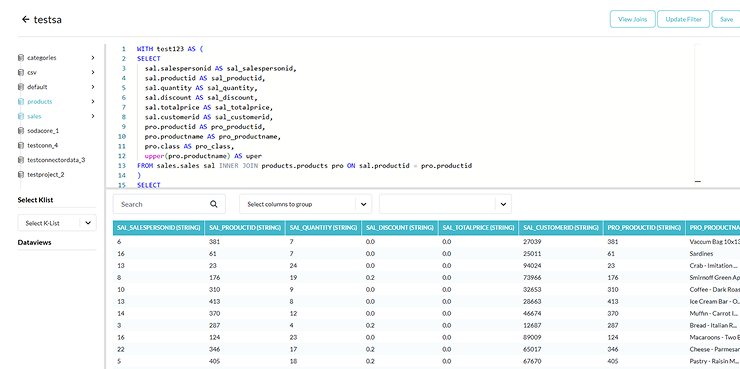
Curated, Analysis-Ready Datasets
Data Views in Datazenx enable users to combine multiple data sources into unified, query-ready datasets. By applying joins, filters, and transformations, Data Views simplify complex data preparation and make analytics more accessible.
Key Features:
- Data Aggregation: Combine multiple sources into a single coherent view.
- Transformations & Filters: Apply business logic to refine datasets for specific use cases.
- Exploration & Management: Create, view, edit, and manage datasets with a user-friendly interface.
- Reusability: Once created, Data Views can be reused across projects, workflows, and analytics dashboards.
Data Views act as the bridge between raw data and actionable insights, ensuring that data is reliable, consistent, and ready for decision-making.
Data Products #
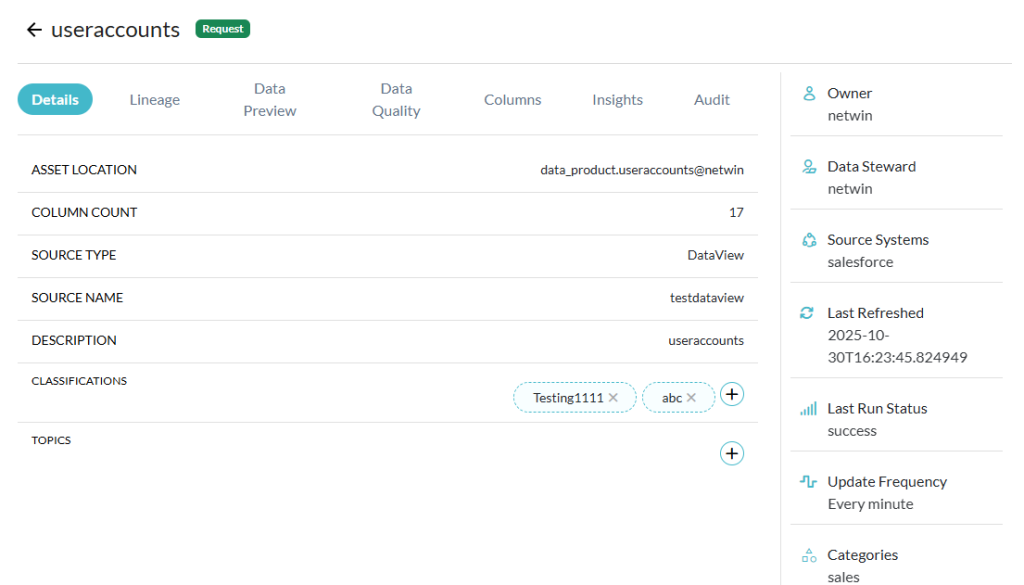
Trusted, Governed, and Discoverable Datasets
A Data Product is more than just raw data. It represents a well-defined, quality-assured dataset, enriched with metadata, lineage, and governance policies for secure and efficient business consumption.
Each data product includes:
- Product Name & Description: Unique identifiers and purpose of the dataset.
- Asset Location & Source Systems: Where the data is stored and its origin.
- Data Owner & Steward: Responsible stakeholders ensuring accuracy and compliance.
- Domain / Business Unit: Business context for relevance.
- Lineage & Transformation Details: Full traceability from source to current form.
- Data Quality Rules: Validation, cleansing, and compliance standards applied.
- Access Policies & Tags: Permissions and search-friendly categorization.
- Usage Metrics & Refresh Frequency: Monitoring dataset utilization and timeliness.
- Glossary Terms: Linked business definitions for clarity and consistency.
Data Products provide organizations with confidence in data quality, governance, and accessibility, enabling stakeholders across teams to consume data efficiently without ambiguity.
KLists #
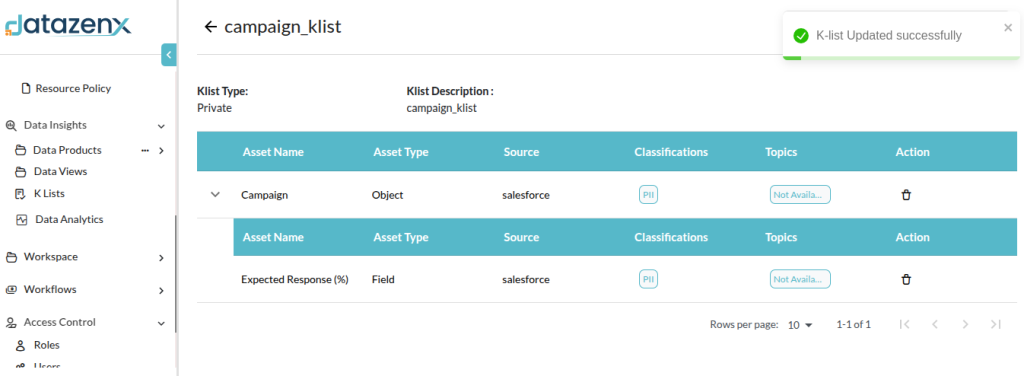
Reusable Collections of Trusted Entities
KLists streamline repetitive data tasks by enabling users to create and manage collections of frequently used entities such as applications, tables, fields, or database columns. Once created, these lists can be reused across workflows, Data Views, and Data Products.
Benefits of KLists:
- Efficiency: Reduce repetitive selection of entities across projects.
- Consistency: Ensure uniform usage of trusted entities in analytics and workflows.
- Ease of Access: Create KLists from the Data Catalog by selecting relevant tables, fields, or objects.
- Workflow Integration: Use KLists directly within Data Views and Workflows for faster execution.
By centralizing commonly used entities, KLists help teams save time, improve consistency, and focus on higher-value analysis.
FAQ #
1. How is DatazenX different from BI tools?
DatazenX focuses on preparing, governing, and delivering trusted data, not visualization alone.
2. What are Data Views used for?
They simplify complex data by providing curated, analysis-ready datasets.
3. What makes a Data Product different from a dataset?
A Data Product includes governance, ownership, quality rules, lineage, and usage metrics.
4. Who can consume Data Products?
Both technical and business users, based on access policies and roles.
5. Can Data Products be reused across teams?
Yes. They are designed for enterprise-wide reuse and consistency.