



Centralized Data Catalog for Unified Discovery #
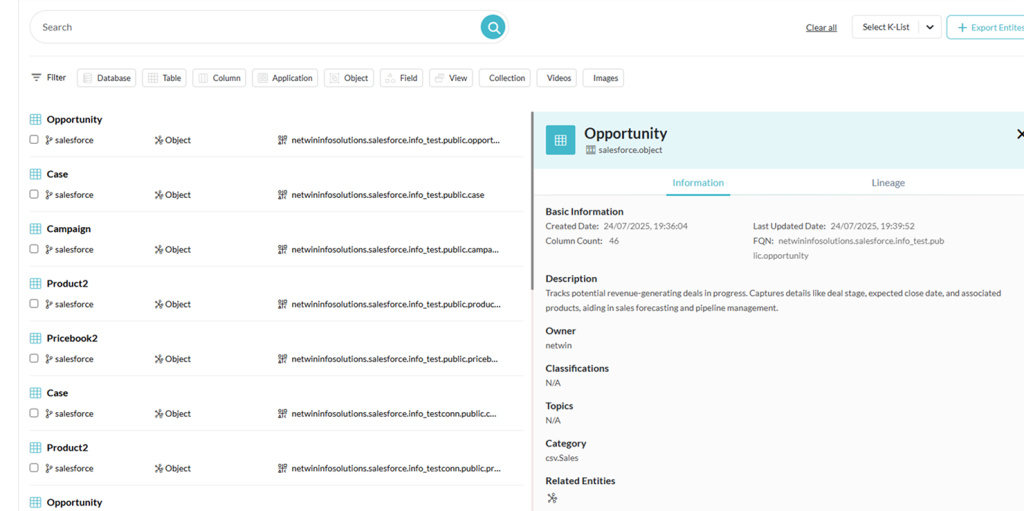
The Data Catalog in Datazenx serves as a centralized repository for all data assets ingested from connectors, providing users with efficient discovery, governance, and contextual understanding of enterprise data. It enables teams to explore, organize, and manage data across systems while maintaining consistency, quality, and compliance.
Through a unified catalog, Datazenx ensures that stakeholders, from data engineers and analysts to business users, can quickly find the data they need, understand its context, and confidently use it for analytics or operational purposes.
Business Metadata: Contextual Intelligence for Data Assets #
Datazenx captures comprehensive business metadata to ensure assets are fully understood across the organization. This includes:
- Asset Descriptions: Detailed explanations of datasets, tables, and objects for clarity.
- Business Definitions: Standardized definitions aligned with organizational terms to avoid ambiguity.
- Owners & Stewards: Assigned individuals or teams responsible for asset quality, governance, and usage.
- Usage Context: Insights into how and where data is consumed, enhancing trust and usability.
Business metadata not only supports data governance and compliance but also promotes collaboration across business and technical teams.
Technical Metadata: Structured Data Understanding #
Alongside business context, technical metadata provides a precise understanding of the data’s structure and system attributes. This includes:
- Schemas & Data Types: Information about the organization of tables, columns, and relationships.
- Source Systems: Identifies where each dataset or asset originates.
- System-Level Attributes: Includes storage details, ingestion frequency, and processing metadata.
This combination of business and technical metadata ensures full data lineage and transparency, enabling data engineers, analysts, and governance teams to make informed decisions.
Data Classification: Security and Compliance by Design #
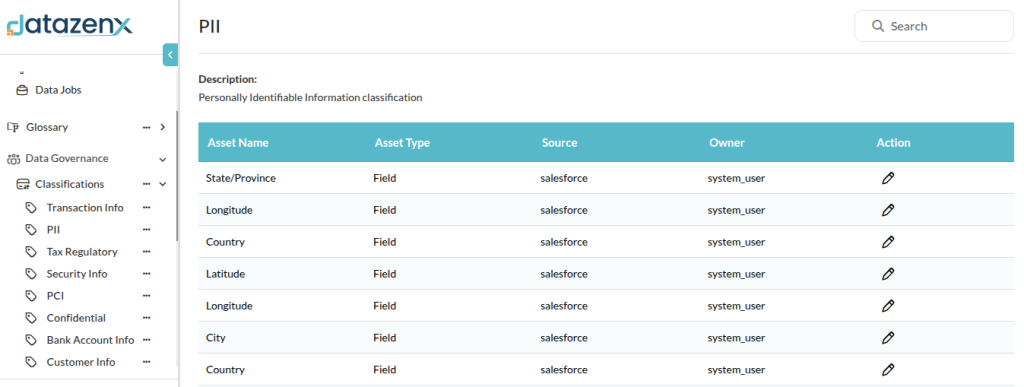
Datazenx provides robust data classification capabilities to categorize assets based on:
- Sensitivity Levels: Personal, financial, or confidential data.
- Usage & Access Controls: Governing how assets are consumed and by whom.
- Regulatory Compliance: GDPR, HIPAA, or industry-specific standards.
Classifications are applied at the entity level, enhancing data governance, security, and discoverability.
Search & Discovery: Find Data Fast #
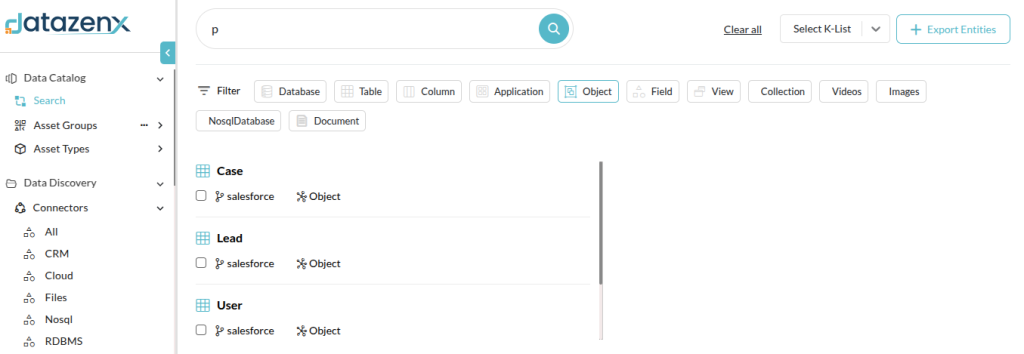
Users can quickly locate relevant assets using advanced search, filters, tags, and relationships. The catalog allows:
- Full-Text Search: Locate assets by names, attributes, or tags.
- Filtered Views: Narrow results by asset type, business domain, or classification.
- Relationship Navigation: Explore related datasets, tables, or objects to understand dependencies and impact.
This ensures data discovery is intuitive, fast, and contextually rich, supporting analytics, reporting, and operational workflows.
Asset Groups: Organize Data by Business Domains #
Asset Groups in Datazenx categorize assets according to business usage domains, such as CRM, Marketing, or Commerce. Key features include:
- Domain-Based Organization: Ingest assets from connectors and classify them under relevant groups.
- Metadata Enrichment: Apply classifications, business topics, and contextual tags to improve governance.
- Entity Exploration: View detailed metadata for tables, columns, and objects.
- Relationship Visualization: Understand dependencies, lineage, and cross-asset connections for better impact analysis.
Benefits:
- Streamlined navigation for analysts and business users
- Enhanced contextual understanding of enterprise data
- Improved governance and compliance visibility
Asset Types: Navigate Data by Technical Classification #
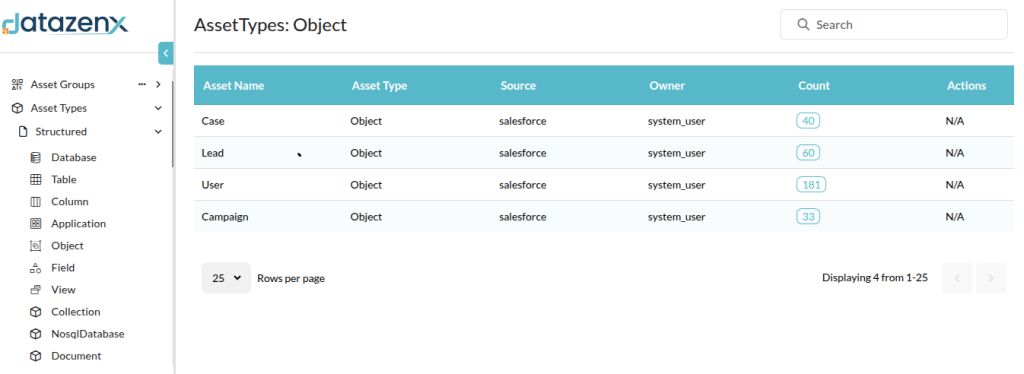
Datazenx allows users to classify assets based on technical type, supporting both structured and unstructured datasets:
Structured Asset Types:
- Databases, Tables, Columns
- Ideal for schema-based, relational data sources
Unstructured Asset Types:
- Audio, Image, Video, Mail, Chat
- Typically stored in content management or media repositories
Capabilities within Asset Types:
- Explore Entities: Detailed view of metadata, source, and attributes
- Apply Classifications & Topics: Ensure compliance and enhance discoverability
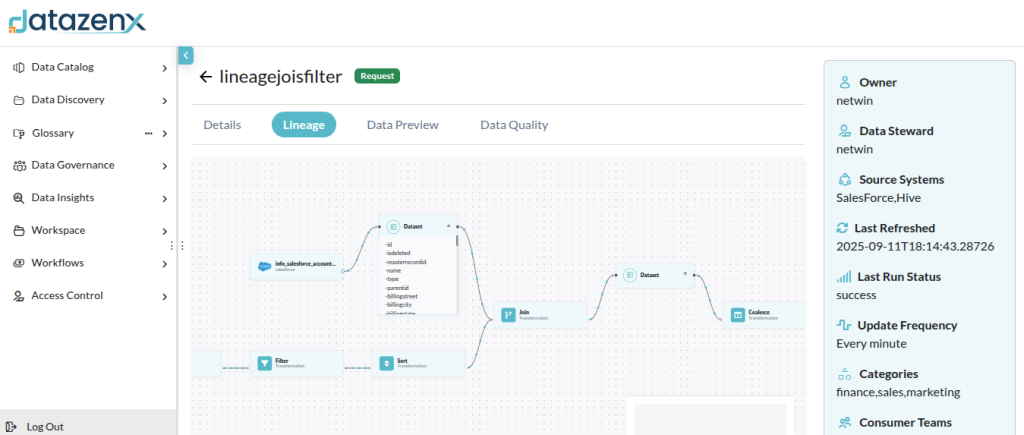
- Analyze Relationships & Lineage: Visualize how assets are connected across projects
- View Related Entities: Identify dependencies and cross-asset connections
Benefits:
- Faster access to data for analytics and reporting
- Improved governance and compliance through structured classifications
- Enhanced discoverability for technical and business users
Key Keywords & Concepts for Data Catalog #
- Metadata Management: Centralized control of technical and business metadata
- Data Governance: Policies and classifications applied to assets
- Data Lineage: Traceability from source to usage
- Asset Discovery: Efficient navigation of datasets, tables, and objects
FAQ #
1. Does DatazenX ingest both technical and business metadata?
Yes. It captures schemas, lineage, and system metadata along with business definitions and ownership.
2. How is metadata kept up to date?
Through automated MetaJobs and scheduled ingestion from connected systems.
3. Can users search data using business terms?
Yes. The catalog supports full-text search, tags, classifications, and glossary-driven discovery.
4. How does DatazenX handle sensitive data?
Through classification, policy enforcement, and governed access controls.
5. Can I visualize data lineage across systems?
Yes. DatazenX provides relationship and lineage views for impact analysis and traceability.